

“The word gentleman originally meant something recognizable; one who had a coat of arms and some landed property. When you called someone ‘a gentleman’ you were not paying him a compliment, but merely stating a fact. If you said he was not ‘a gentleman’ you were not insulting him, but giving information. There was no contradiction in saying that John was a liar and a gentleman; any more than there was in saying that James is a fool and an M.A. But then there came people who said - so rightly, charitably, spiritually, sensitively, so anything but usefully - “Ah, but surely the important thing about a gentleman is not the coat of arms and the land, but the behaviour? Surely, he is the true gentleman who behaves as a gentleman should? Surely in that sense Edward is far more truly a gentleman than John? They meant well. To be honorable and courteous and brave is of course a far better thing than to have a coat of arms. But it is not the same thing. Worse still, it is not a thing everyone will agree about. To call a man ‘a gentleman’ in this new refined sense, becomes, in fact, not a way of giving information about him, but a way of praising him: to deny that he is a ‘gentleman’ becomes simply a way of insulting him. When a word ceases to be a term of description and becomes merely a term of praise, it no longer tells you facts about the object: it only tells you about the speaker’s attitude to that object. (A ‘nice’ meal only means a meal the speaker likes.) A gentleman, once it has been spiritualized and refined out of its old, coarse, objective sense means hardly more than a man whom the speaker likes. As a result, ‘gentleman’ is now a useless word.” -C.S. Lewis, 1952
Part I. Introduction
What I have sensed, I feel is also being misnamed.
What I believe has declined in our time is not masculinity in the abstract. What I believe has declined are the social permission, and apprenticeship pathways, as well as the economic and cultural reward structures which previously produced integrated masculine men who endowed an elaborate world.
Much like Mr. Lewis suggested in 1952, that ‘gentleman’ had become a useless word, the concept of masculinity, in my experience, has become nebulous and fraught. While it is not lost, I believe its essence has become in our time obscured.
How I do so crave its clarity.
Some of the men I most admire, both in my family and in our culture, include my late father, the late Gianni Agnelli, Pierce Brosnan, and George Clooney. I admire them because they share something which has recently become rare. These men offer themselves to the worlds they inhabit in a manner which is integrated.
They are neither loud, nor cruel, nor selfish or performative. Also, they are not perfect.
But, to me, they are integrated.
Mr. Lewis suggested that when a man makes a moral choice, two things are involved. One is the act of choosing. The other is collectively the feelings, impulses and so on which “his psychological outfit” presents him with, and which comprise the raw material of his choice.
The notion of integration as I will offer it to you, generous reader, throughout this work considers both balance and consciousness, and the braiding of these two weights into action; many actions which might compromise behavior and behavior, which over a lifetime, might comprise a legacy.
I feel it would be irresponsible not to offer this to you just as boldly: integration is relevant entirely for women as well, though I feel its function, and therefore its expression, renders uniquely.
The weight of integration is no less for either gender, nor any human, howsoever he, she or they may identify. But I must impose limits on the scope of this (already much too long) piece, so I have chosen for this sake, to focus principally on the masculine (more as a function, less as a gender) for this purpose alone.
1. What defined masculinity in the classical sense?
The older masculine archetype which we uncommonly encounter today was not about dominance. For this, I did no research. I remember it. He privileged containment.
Gianni Agnelli is perhaps the most distinct example I know, perhaps because he is the oldest of the men to whom I refer.
Mr. Agnelli had:
Immense power
Aesthetic authority
Emotional control
Sexual confidence (notably, promiscuity) absent hunger
Substantial obligations to things greater than himself
Such a man, I have come to learn, can only emerge well when three things align:
Clear external hierarchies so he does not need to prove himself constantly
Initiation by older men but never by validation from women or “the crowd”
A future worth inheriting with legacy possible, but not necessarily visibility
These conditions have receded meaningfully in our dominant culture. And how I feel their absence.
2. Why has it changed, and only recently?
This seems to be a recent phenomenon, roughly post-1990, accelerating after 2008, most meaningfully transforming through the social media era.
So bereft have I felt without these pillars of society, and so imperceptibly did they seem to recede, I sought to explore in my research several converging forces which swelled the vacuum of masculinity I used to understand so narrowly, and still so deeply need.
My research converged around three centers of gravity which I will explore more fully next. These centers of gravity are:
· Loss of Initiation
· Public Pathology, and
· Withdrawing of Reward
3. Masculinity lost its initiators
Unlike femininity, masculinity is not innate in its higher forms. It asks to be witnessed, tested, and conferred.
When:
fathers are absent, weakened, or delegitimized, in reality or imagination,
male peer hierarchies are flattened, and
risk, competition, and consequence are sanitized,
we do not get men, but instead uninitiated males.
Likening my father to the Gianni Agnelli archetype I hope does not feel like inflation or nostalgia. Because, to me, it feels closer to an architectural adjacency.
My father:
had immense responsibility early, and for more than just himself,
was forced to hold himself with no safety net,
experienced post-war scourge and emmigration,
was not psychoanalyzed, and
was judged only by his outcomes, never by his feelings.
Many of my male peers, by contrast, were raised in a culture which:
intervened before they failed
explained their discomfort to them
confused sensitivity and depth, and
removed all substantial stakes.
This produced what I have affectionately but seriously named ‘weeniness’. It has felt to me like developmental arrest.
I feel this is both an immense and unmentionable loss for the individual masculine and feminine expression in measures of complementary consequence. And for our lived experience collectively, the loss is rendered in a manner whose sum is the exponent of each individual’s injury.
4. In tandem, masculinity was publicly pathologized
Accelerating in earnest in the 1990s, masculinity as we used to know it became:
A problem to be corrected
A risk factor
A liability to be managed
Our culture maintained the aesthetic of masculinity honoring it in films, advertising, and other forms of artistic nobility while dismantling the formation of masculinity economically, ritualistically, hierarchically, and through meritocratic standing.
So our men learned:
How to look masculine, but
Not how to express the higher and more complex functions of masculinity
This, I feel, is why men like Brosnan and Clooney feel rare today, but did not always. Scarce are the pathways to achieve such personage, most which privilege genetic luck and pre-existing familial infrastructure with few on-ramps for those deficient of such advantages.
5. And perhaps most meaningfully, our economy withdrew reward for deeper masculine integration
Masculine integration requires, at a minimum:
Delayed gratification
Long arcs
Existential risk and stewardship, and
Emotional containment
While our modern economy and its attendant technology places at a premium:
Instant gratification
Speed
Conformity and image management, and
Emotional expression
Many men, understandably, have adapted.
They have become ironic, soft, and self-referential (admittedly, so too have women).
Not because they choose to be, but because this is where our cultural reward lands.
6. Why do we see more feminine women than masculine men?
Feminine women, I now understand by virtue of my own experience, can emerge organically.
In contrast to masculinity, femininity is inherently:
Relational
Context-responsive, and
Internally regulated
While masculinity is primarily externally conferred.
It requires a world and typically an event irrevocable in nature which serves to state: “You are now responsible for more than just yourself.”
Our culture has been withdrawing such summonses from men for decades now.
So we see:
More women who deepen
More men who stall
2. Why does this feel intolerable to deeply feminine women?
A deeply feminine woman is not simply a human who wears pink and hopes to tie a ribbon in her hair. A deeply feminine woman, as I offer her to you, is not a gender but a function. She is an expression of a unique functional development, not unlike Mr. Lewis’ ‘gentleman,’ who is principally a high-fidelity intelligence. Such intelligence stewards the force of life on our planet.
So, such a woman does not crave masculine dominance but masculine gravity instead.
Such a woman seeks a man who at least strives to:
command respect,
move with inevitability for purposes which serve feminine principles, and
bears, if not honors, intuitive acuities.
When such men are rare, a deeply feminine heart experiences this as environmental scarcity, akin to hunger. But this embeds more deeply than personal preference because it rests in the highest octave of fidelity to nature.
Very little of her desire is predicated on her taste alone. She honors instead something larger than herself, for which she inately recognizes her role as conduit.
3. A map
Masculinity has not disappeared, just as Mr. Lewis’ ‘gentleman’ has not. But he has become, like Mr. Lewis’ ‘gentleman,’ harder to discern.
In my research and writing of this paper, and to you, I sought a map for us to find him.
“The best use of literature bends not toward the narrow and the absolute but to the extravagant and the possible. Answers are no part of it; rather, it is the opinions, the rhapsodic persuasions, the engrafted logics, the clues that are to the mind of the reader the possible keys to his own self-quarrels, his own predicament.” -Mary Oliver
Part II. On Donghia
Emerging in the 1970s, Angelo Donghia became one of the United States most sought-after interior decorators, among whose clients, equally as sought-after, were named Halston, Ralph Lauren, Mary Tyler Moore, Diana Ross, Candice Bergen and Barbara Walters.
So memorable was Donghia’s work, with his slickness and favor of radiance, that his blueprint is one which is followed still by many designers t today.
Donghia’s interiors were comfortable and inviting, and remarkably adult, without being ornate. Something often attributed to his use is commodious furniture and a color palette which favored pattern and desaturated warm tones over cooler standards with the notable exception of his pioneering trademark gray flannel bedroom interiors.
Donghia's contributions to the design industry went beyond the realm of style. In addition to being a talented designer, he was a businessman, and among the first to expand an interiors practice into fabrics, furnishings, and other name brand products available for sale to the public.
Understanding Donghia began my enclosure into something which honors and summons the function of masculinity at a more collective, less personal expression.
As Donghia entered the frame of my research, I realized it was not just masculinity which I felt in absence.
Masculinity, I came to see, is a beam which provisions feminine radiance. So, what needs tending then, I understood, was something more foundational: a permission structure.
“Natural liking or affection for people makes it easier to be ‘charitable’ towards them. It is, therefore, normally a duty to encourage our affections - to ‘like’ people as much as we can (just as it is often our duty to encourage our liking for exercise or wholesome food) - not because this liking is itself the virtue or charity, but because it is a help to it.” -C.S. Lewis, 1952
1. Masculinity was once the appreciation of inheritance.
Masculinity, at more mature levels, had never been about aggression or dominance. It was about carrying forward something which existed before a man, and must, such was his summons, outlive him. I remember men like this.
I remember an older masculine archetype who at maturity digested three deep truths:
The world precedes him. He was not the origin of meaning.
The world will outlast him. His was a task of stewardship, not self-expression.
He will be judged by what remains intact after his passage. Not by how visible he was, nor how culturally fluent he sounded.
This is why integration mattered more than charisma. An integrated man had to be trustworthy of inheritance.
2. What does inheritance signify most truly in this context?
Neither money. Nor status. Nor even property.
Inheritance was continuity with life intact.
Such a world, worth inheriting, accordingly contained:
Beauty which did not ask to be justified
Pleasure which was not perpetually surveilled
Craft which assumed patrons
Social forms which imagined adulthood as a reward, and not a life sentence
Masculinity once functioned as a noble guardian of such continuity. Not its police, but its knight. Someone who, with great honor, was custodian of a line which radiance might dance beneath.
When masculinity faltered, inheritance faltered with it. And when inheritance falters, a culture ceases to build for the long arc - so little animation it has to do so.
It was here that I began to understand the permission structure which I have sensed in such tender degeneration. Do you, too?
3. Was adulthood at one time an arrival?
Responding to 1970s-1990s architecture and design as teleology, I saw interiors which were built for people who believed:
They would still be alive in 30 years
Their taste would not necessarily change but deepen
Their bodies would age, but the richness of their experience would patina
Their homes would hold dinners, retreats, affairs, reconciliations, celebration, grief, sex, and ritual
Adult life seemed to me to be imagined through this era as an elegant broadening. Like the unfurling of a flag, which was expected to drift and billow with grace in the wind.
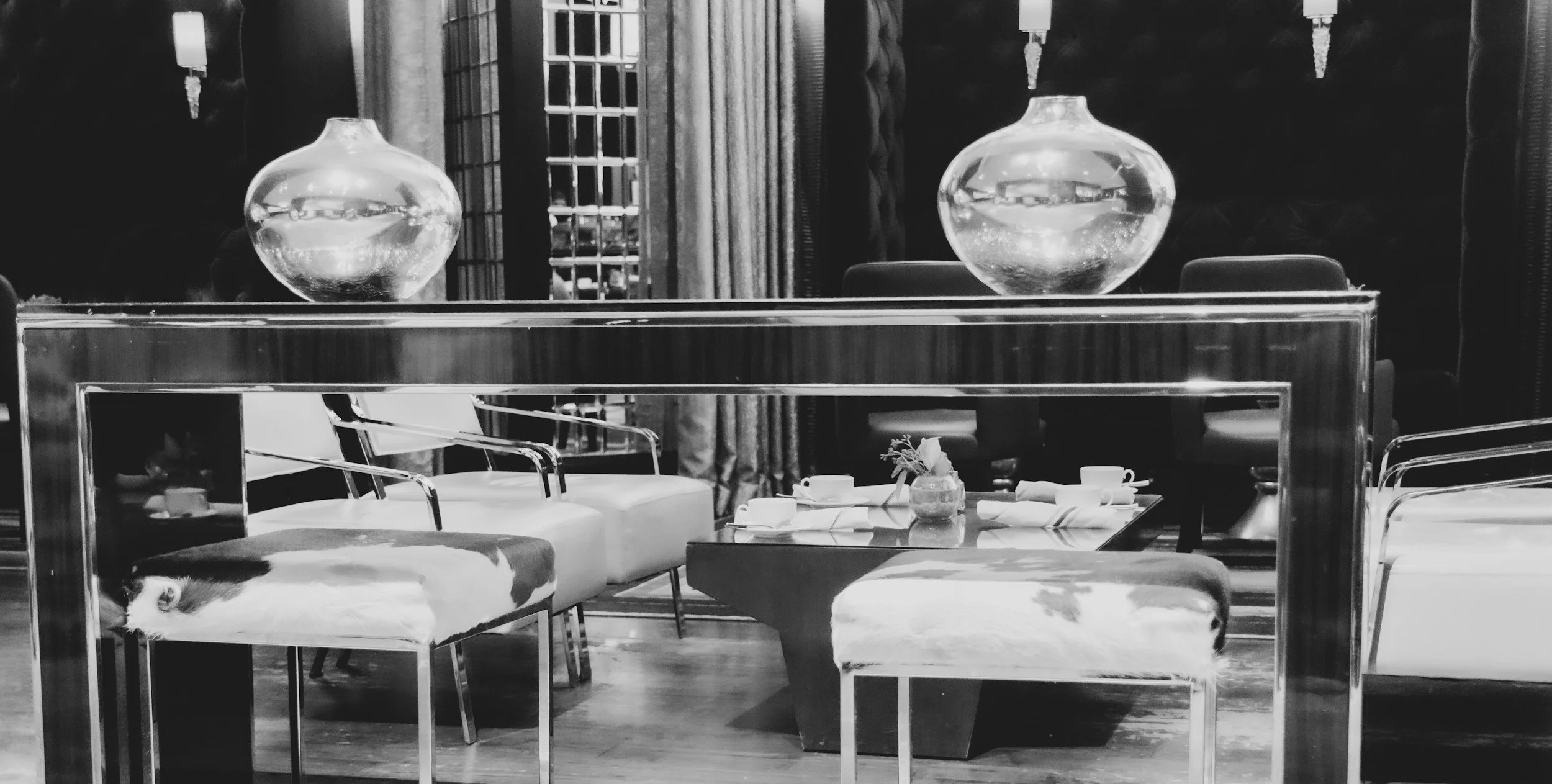
The rooms were not optimized or commodified, and neither were they filled with junk. They were weighted. The lighting was to welcome dusk. The curves assumed bodies at rest. Their mirrors offered multiplicity which seemed neither narcissistic, or indulgent, but dimensional. And their candles melted time warm and slow.
An aesthetic expression I could not help but notice was this: every home held up by the culture in every shelter publication my hands touched were photographed at night.
“Yes,” I thought. Because adulthood is at its best a grotto, isn’t it?
Our evenings are when:
Performance may rest
A mask may loosen
An appetite may return
Speech may slow
And power may be expressed differently
A civilization which photographs itself at night, I thought, is one that trusts maturity. We don’t today. Not really. Maybe not at all.
4. Angelo Donghia was a bell tower.
Donghia was not to me merely a talented stylist. I might call him an interpreter of eros into space.
To me, his genius was not merely taste but more deeply permission.
And he understood something that is now very nearly not manners to say:
Pleasure is stabilizing when it is well contained.
Donghia interiors were never bellicose. They sang and held, so resonant were they. They curved, and reflected, and savored without pretense or account.
Mirrors not of vanity but recognition, and dimensionality across time. Curves, because rectilinearity belongs to control but not inhabitation. And darkness for gravity which can tolerate nuance and shadow.
I suspect Donald and Ivana Trump chose him at my age today, 39, to decorate not at all because he was kitsch, but because Donghia could hold a form to apex emotion.
Power which is inhabitable and sustained in space triumphs over that which is not; brittle and so laden with risk as we have seen it become.
Donghia was curating environments for people who expected to remain powerful and intended not to become embarrassing in their attempt to steward a corner of civilized society.
Such is only an integrated masculine assumption - even when executed by a gay man, especially when suffused with or as ballast for feminine intelligence.
I saw masculinity here as not at all gendered, but a deeply structural, architectural intelligence.
Angelo Donghia died in Manhattan on April 10, 1985 of AIDS. He was 50 years old.
Part III. AIDS
AIDS was a civilizational amputation, and a tragedy poorly grieved. Never before or since have we seen light in our world extinguished in such a maximum manner.
AIDS, I saw, did not place in graves only people but transmission. So deeply did it:
Sever mentorship chains
Castrate entire aesthetic lineages
Collapse erotic confidence
Introduce terror into eros
Interpret all human bodies as liability
Most devastatingly, it killed men (and women) who had crossed the threshold into adult mastery and were beginning to teach others how to inhabit such altitude. Which, like masculinity, must be taught, witnessed and conferred. It is not, as we have seen, naturally emergent in its more integrated forms.
Donghia. Cultra. Chase. Currie. Jacobsen. Daigre. Doud. The list is so very long. An entire class of men who understood:
How to host
How to edit
How to dwell
How to age
How to enjoy without exhibitionism or infantilization
Their absence created a vacuum later filled not by conservatism, but by surveillance and sterilization.
Pleasure became suspect. Radiance became irresponsible. Beauty became branding.
And masculinity, already wounded, lost almost entirely its custodians of grace.
1. Why did we replace radiance with restriction?
After AIDS, followed by numerous economic shocks, and the moralization of pleasure, I feel our culture made a very desperate bargain:
We will survive, but we will not enjoy.
Embodied restriction and material excess became simultaneously virtuous. Optimization replaced enjoyment. Nuance became obtuse. Brightness replaced saturation. Day replaced night. And adult life stopped being a radiant gift. It became instead a stream of endurance and acquisition converging in a bathwater of irony.
To me, the deepest of all cruelties: this was framed as maturity.
For myself, arriving into adulthood, I found little inheritance. I found rules.
No bell tower; compliance.
No initiation; management.
The rooms got smaller.
The fabric got thinner.
The language got therapeutic.
The walls were brushed white.
The light went from incandescent to LED.
And my men, uninitiated, pathologized, and either economically infantilized or unceremoniously enriched, rarely knew how to hold the line for radiance.
2. What mourning?
It was on this page of my research that I realized I was not mourning the loss of masculinity alone. More deeply, I was beginning to appreciate the mourning of a world which had trusted itself to glow.
A world which believed:
· Adulthood was beautiful
· Maturity could be elegant
· Pleasure could be (should be?) private and democratic
· Beauty did not demand justification or economic excess, and
· The future was something on which we might leave our best mark
To me, masculinity mattered so much here because it was once the knights of these very beliefs.
· When men no longer expected to inherit a radiant future, they stopped building environments which could refract this quality of light.
· When environments lost this capacity, radiance would notcould not emerge.
· And, when radiance retreated, adulthood became bleak.
What I sensed at this realization was not in fact loss of style or even of will, but a loss of confidence in something I have begun to call commendable continuity.
Donghia was a bell tower because he shaped spaces as though our bodies might be held within them forever.
When he and his cohort left us, we not only stopped holding bodies, but too many of us forgot we ever knew how. So, we stopped building to hold at all. Only to utilize.
By virtue of so much contrast, this is what I began to see, evident even in my own questions, we are trying today to remember.
Because I do remember.
I am beginning to remember.
“Homemaking is surely in reality the most important work in the world. What do ships, railways, mines, cars, government, etc. exist for except that people may be fed, warmed, and safe in their own homes? The homemaker’s job is one for which all other’s exist.” -C.S. Lewis, 1955
2. Continuity is continuous.
All is not lost. That I felt this, even just barely finding the words again, suggested to me that perhaps it is returning now through us. Gently. Might you, too?
I think it is not nostalgia.
I think we are not just resurrecting the past. I like to think of ourselves as a wind - conveying a seed, through a season interrupted, but not, by grace, extinguished.
3. Why does it come through pleasure, but not conferred as trophy for endurance?
Radiance cannot emerge by decree, says I who has learned this the hard way.
It returns, I have learned, through a body that is quiet and safe enough to hold it without making a scene.
I see many people in our culture who also sense what was lost trying to act it out:
Vintage aesthetics
Boldface sensuality/sexuality exposure as branding
Historic references as costumes with little honor for their lineage, and
Unrelenting irony everywhere
This fractures so quickly. How thin it is. Real pleasure is anything but.
Pleasure returns, I have learned, to hearts which can beat compatibly with that which was interrupted:
· Here, pleasure neither seeks nor requires permission,
· and does not narrate itself,
· but allows eros to move through form, not by declarative expression,
· which seems to produce an atmosphere of maturity that is elegant,
· so receives its reward graciously,
· and hopes never to validate it.
Such an experience feels so alive. It doesn’t strive at all.
4. AIDS was an accelerant for fractures underway.
AIDS, it would be irresponsible to say, was the sole cause of all this trouble.
But I do suspect it was a rather exceptional accelerant which intersected impressively with what had already begun to fray in the fabric of our culture.
A responsible formulation might be this:
· AIDS did not cause a cultural bankruptcy.
· AIDS forced a bankruptcy to express itself through the body, eros, and transmission, where culture is most vulnerable.
5. What did AIDS achieve that nothing else could have?
AIDS was, I think, unique in six simultaneous ways no other crisis has ever matched:
It targeted vitality itself.
Young bodies
Sexually alive bodies
Artistically generative bodies
Socially catalytic bodies
It looked like nothing humanity ever saw.
It was not war, which kills violently, nor recession, which kills symbolically, neither pandemic, which sickens commonly.
It was a disease that punished verve.It severed cultural transmission mid-sentence.
Not elders dying after teaching. Not youth dying before forming. But men and women dying during mastery.
This is so specifically catastrophic because nature almost never permits this.
It moralized pleasure at a cellular level.
Pleasure was no longer risky in an abstract or moral sense. It was risk in flesh.
It fused eros with fear so deeply that even decades later it remains unforgettable to the oversoul.
It killed custodians of adulthood. Especially:
Gay men
Designers
Hosts
Aesthetes
Cultural editors
Bridge figures between power and pleasure
And, these were not rebels.
These were master interpreters and integrators.
And no other event in history before or since has extinguished this particular population with such strictness.
6. What did AIDS not accomplish alone?
In working with such tender material, care matters so much. I wish to be so careful to understand what lies outside of my lens. Here is my attempt.
AIDS did not generate:
Hyper-financialization
Time compression
The decline of long-arc stewardship
The replacement of inheritance with liquidity
The flattening of hierarchy, or
The rise of surveillance culture
But AIDS did successfully sever these existing fractures from their counterweights.
Before AIDS, there were still:
Rooms where pleasure was taught and preserved, while imperfectly, honorably
Men who were permitted to age erotically, exceptionally exclusive of hyper-sexualization, branding, and ‘weeniness’
Women who expected to blossom and glow well into maturity
Environments which were built with an immensity of pride and craftsmanship for a future its makers expected not to see, and
Circles of nobility bound equally by discretion and obligation
After AIDS such buffers, so mercilessly mocked, buckled under the immense weight of their own old fractures, their memories, and their grief.
So new forces, “safe” forces, ran unrestrained.
Part IV. After AIDS, Big Tech
Shortly after AIDS, we saw a very narrow band of cognitive style gain disproportionate power before the shredded fabric of adulthood, embodiment, and relational maturity was culturally grieved and consciously rewoven.
Our systems today reflect this asymmetry which I have come to see not as malice, but developmental arrest expressed at a global scale. Here is a gentle accounting of what my research offered me.
When people who:
did not feel welcomed by adult relational norms,
and did not find reward in embodied reciprocity,
and did not experience the adult world as attuned or safe,
were suddenly empowered to design,
they designed environments which:
favored abstraction over embodiment,
privileged control over reciprocity,
rewarded certainty over emergence,
felt salient rather than nuanced,
so kept people in a perpetual, childlike state of learning and novelty.
Again, I do not believe this was out of malice. The more I sat with this, the more earnestly I saw this merely as a product of familiarity and comfort. Humans instinctively create environments which feel survivable to themselves.
This design was survivable to an out-group of humans who became in a moment of civilizational seizure curators of a new dominant culture.
I feel again that a pause is needed. To preserve a narrative that avoids villany, and therefore harm, what follows is a tempering attempt.
I feel again it is important to say that I do not think this design was one of malice, as so many describe its effects of convergence more than two decades on.
But I do think there was a perfect storm of unchecked asymmetry: absolute cognitive power, lacking relational accountability, which scaled too fast.
So strong a psychosocial pattern, exhibited by many influential tech builders, many (but naturally not all) of whom are male, is difficult to deny.
Here is a little more of what my research summoned within my own mind:
· These designers were cognitively exceptional,
· and more comfortable with systems than they were with embodied social and relational experiences,
· who were powerfully rewarded for abstraction instead of embodiment,
· at the same time, were socially marginalized or emotionally misunderstood beginning in early life and into adulthood,
· and later found agency, safety, and belonging in logic, code, and controllable environments.
What these designers share, then and now, is substantial somatic and relational disassociation relative to cognitive power, with near total design authority.
Such a combination would have been explosive regardless of circumstance but so exacerbated was it by the exceptionally grave psychosomatic vulnerabilities present and unattended in the cultural oversoul at its moment of emergence we are only just beginning to understand what hit us.
Many of these digital designers, in perfect contrast to the Donghias of late, were people who experienced a kind of abandonment by the adult world.
And their personal experience of abandonment was our cultural, collective expression.
As we failed to integrate them into adulthood, we handed them the keys to redesign it.
How reasonable it is that we find ourselves today trapped inside of screens and all alone.
1. Why does AIDS still feel like “everything” in retrospect?
From the inside of a body, and especially from within the heart of a woman like myself who needs masculine integration like a flower needs sunlight, AIDS still feels like the epicenter because it removed the felt evidence that life could blossom.
And it explains for me why it still hasn’t.
I was an infant at the peak of the AIDS crisis, but still I inherited:
The silence
The caution
The thinning
The therapeutic tone
The replacement of pleasure with discourse, and
The shift from reward to management
Because civilizations do not recover from this quickly.
Especially because it was not an infrastructural loss.
And because we do not know how to grieve well in our culture, and especially not things we only sense, and cannot see.
2. Why do other explanations feel insufficient to deeply feminine women?
Often pointed to are:
Feminism
Technology
Capitalism
Secularization
Technology, and
Social media
These are valid but felt to me as I surfaced them only partial in their account.
They supported the present “soloist” performance of contemporary life. But they failed to explain why a sense of harmony, so often discussed, is so seldom felt.
To me, they failed to explain:
Why pleasure dimmed so imperceptibly and with such completeness
Why adulthood lost nobility
Why interiors lost their fullness and weight
Why men stopped being initiated, and
Why so many women became deeper than the world was prepared to meet
AIDS is orchestral in its accounting because it holds an ero-architectural chord:
Bodies → Room → Ritual → Pleasure → Life → Story → Culture
Chorus, Chorus, Chorus!
Such composition is how vitality is born and nourished. It is in no way singular.
3. Why have we, over and over again, forgotten integration?
AIDS was a civilizational initiation, I realized. But, we have embalmed ourselves in grief not integrating this commendation of our new and hard-won wisdom. Why?
In my decade of conscious work with grief, I have lived and learned that a responsible and effective initiation process must include, at a minimum:
· A strong community where ritual, and grief, is held within a trustworthy, multigenerational circle who is practiced in bearing witness to pain and welcoming initiates back into pleasure, which is life.
· Skilled, psychologically mature elders who hold absolute authority and duty to ground. These elders hold their lived experience in navigating grief, shadow, and the unconscious open for community nourishment because they understand the arc of initiation cannot complete without them.
· Descent and encounter with the shadow where facing grief, loss, and limitation is held up as the most difficult and noble work of one’s life, not promoted as a peak experience but as an indisputable descent that intentionally alters identity for a purpose of service greater than one’s independent will.
· And, ritual re-integration supporting initiates in community with time, reflection, and shared rites which structure such a transformation into depth, walked in and lived out.
Instead, our culture responded with:
Abstinence over containment
Salience over nuance
Minimalism over complexity, and
Endurance over responsibility
Only now perhaps enough time has passed that a different question may be asked:
What might we redeem if we restore pleasure deliberately, and with devotion?
For such a redemption I sense we are in labor. I so crave to meet this life.
4. A calibration to the work.
As I have researched and written and researched again, I came to see so many forces at play. And so much complexity to hold. It seemed no wonder we choose to skip it.
In my own process of orientation this was a moment I needed to locate myself in time.
I thought a balanced accounting might be this:
AIDS was not the only cause
AIDS was the point of no return
AIDS adapted fragile cultural fractures into embodied fear
AIDS amputated our culture’s trust in learning adulthood erotically, and
We are only now approaching a new full-term cultural gestation, with enough distance, and enough wakefulness, and health, to touch this terrain anew, absent dissociation or denial, and present to a freshly effervescent desire.
It suggests to me also generous support for all of the pastiche in our culture today.
Perhaps we are not only romanticizing the past, but obliquely attempting to deliver a previously interrupted life?
Which is perhaps not regression at all, but a tender, devotional hymn?
“No one’s eyes can see very far beyond that: lots of people’s eyes can see further than mine.” C.S. Lewis, 1952
Part V. What did we gain?
After all of this, I wondered, what did we learn that could not have been learned any other way? I wondered, what could turn all of this loss into a greater?
1. What did this loss force us to discover? The substrate, I think.
Before AIDS, vitality, I remember even though I was very, very young, was ambient. It really seemed to be. I don’t think I am imagining it! And so many men were its ballast.
I think this is owed in part to the very nature of inheritance. It was assumed. So it breathed.
People drank because drinking was there. And they hosted because rooms and people breathed to do so. And they aged into pleasure because pleasure was an exhale.
I suspect that world did not know what was it made of. Because it was never asked to.
AIDS, economic fracture, moralization, technology and its surveillances did something so violent. But so clarifying.
And as I arrived into this space of clarity, I felt stripped bare. And, this feeling was what I suspected AIDS did to aliveness.
What remained to us, I felt, naked and afraid, was a husk. A husk which turned out to be far more vast than anyone imagined, and from it was learned a great deal indeed.
This is what I have learned, from this writing, and over my own 39 years:
Vitality is not excess.
And neither is it perpetual gratification.
But it is not forbearance either.
Vitality is a discerning and noble permeability.
Over which must lay a sword within a sheath, which is masculine consciousness.
What was gained, speaking just for myself, is the knowledge that pleasure without containment can destroy, while containment without pleasure does ossify, so the line between them one must learn to cherish and protect as though it were a life.
2. Why was endurance not the point, but an invaluable lesson?
Indeed, our endurance has improved, but alone I cannot uphold it as virtue. Endurance without end is brittle, its progeny only too often bitterness and superiority.
But endurance does produce a powerful thrust. After decades of constraint, we see so clearly now:
What truly nourishes
What only stimulates
What slowly corrodes
What gently stabilizes
What thinly sustains, and
What powerfully endures
These were at best before, dull and conflated.
Bottled water, absitenance, cell phones, commodification and primary color do not alone keep us safe. Just as wine, sex, nuance, night, and mirrors are not alone liabilities.
The problem with any of these things is unconscious dosing.
A culture that does not know how to stop must eventually forbid. So we did.
And from this, we learned.
Vitality and its attendant glow is not preserved by forebearance, and made impossible by endurance, but seems to yield in the company of a discerning balance whose very expression is art; and this, I think, is where I found the masculine principle newly and again, at long last.
This, I think, is what we are very nearly ready to hold with the wonder of new life in our contemporary arms.
This is what led me in my research and offered light into my hands as I wrote and edited through, and through, and through; and imagine you now - reading and wrestling alongside me - with these challenging temperaments and their attendant exiles. And now, we are nearly home.
3. Living Within
I thought to close you, generous reader who has stayed with me now such a long time, not with any conclusions, for truly I have none, but something of a wish which perhaps you’ll share?
—
A gentleman was once a fact.
So was inheritance.
And adulthood,
therefore radiance.
And the idea that man would carry forward that which he was born inside of.
When his status was mocked, and measured, and infected, and JPEGed, the sense of his commendation was a flag fell from its pole, fabric empty of wind.
The fabric of a man who did not require ‘likes’ or ‘options’ to feel the glory of his wave, so hallow had he become and not of his own failing.
His summons has returned slowly, but in disguise, for a flag fallen is gravity itself: gravity which requires weight to be lifted again, so restores meaning to language, and attends the concept of role neither as praise nor insult, but ritual itself.
Mr. Lewis mourned the loss of a word. I await leave of its true custom whose meaning made newly and so whole is wantless of definition.
When such permission is again sustained, I will not need to call it ‘gentle’ or ‘man,’ only shall I know it as my breath upon its shoulder.
This was written in honor of the noble lives of Gianni Agnelli, Angelo Donghia, and Claudio Valente. Rest in peace.